

Can losing weight reverse prediabetes? What the Diabetes Prevention Program found, how much weight loss matters, and gentle ways to start.
More than 2 in 5 American adults have prediabetes, according to the CDC. That's a lot of people, and for many of them the news shows up as one line on a lab report with very little explanation attached.
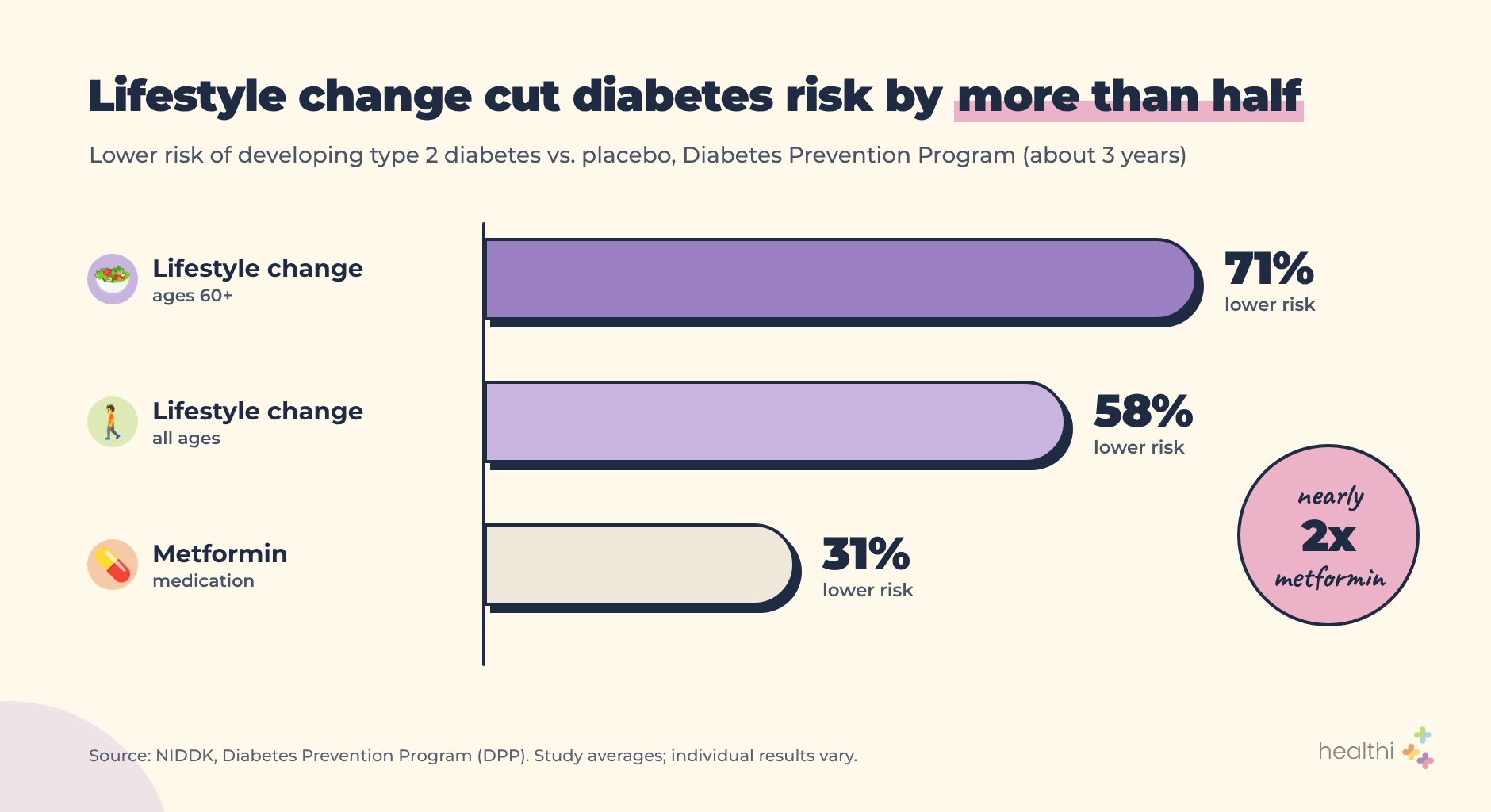
So, can losing weight reverse prediabetes? It can help a great deal, and it's one of the most effective tools we know of. In the national Diabetes Prevention Program, people who aimed to lose about 7% of their body weight and stayed active lowered their chances of developing type 2 diabetes by 58% compared with placebo.
If you're using the Healthi app, the everyday habits that matter most here (meals, steps, sleep) are exactly the things it helps you notice.

Prediabetes means your blood sugar is running higher than normal, but not high enough to be called type 2 diabetes. Your provider usually spots it on a routine blood test, which is why it so often comes as a surprise. You probably felt completely fine the day before you found out, and you probably feel fine now.
That's part of what makes it tricky. There's no symptom nudging you to act, just a number and a word that starts with "pre." And that little prefix can stir up a lot. Some people feel a jolt of worry. Some feel guilty, as if they should have seen it coming. Others feel oddly relieved to finally have a reason for the changes they've been meaning to make.
All of those reactions make sense. The most useful way to think about prediabetes is as a heads-up, not a verdict. It's your body sending a message early, while there's still plenty of room to change the story.
And you're far from alone. The CDC's National Diabetes Statistics Report estimates that 115.2 million U.S. adults have prediabetes. If it feels like everyone at your next family dinner might be in the same boat, statistically, a few of them probably are.
Here's what the research actually tested. The Diabetes Prevention Program, funded by the National Institutes of Health, followed adults with prediabetes for about three years. One group worked on lifestyle changes, aiming to lose 7% of their body weight through healthier eating and regular activity. Another group took metformin, a diabetes medication. A third took a placebo.
According to NIDDK, the lifestyle group lowered their chances of developing type 2 diabetes by 58% compared with placebo. The metformin group lowered theirs by 31%. And for participants 60 and older, lifestyle change lowered the risk by 71%.
What's interesting is that the benefit didn't vanish when the study ended. In the long-term follow-up, people from the lifestyle group still had a 34% delay in developing diabetes after 10 years and a 27% delay after 15 years, compared with placebo, according to the same NIDDK summary.
So is that "reversing" prediabetes? Researchers measured something slightly different: whether people went on to develop type 2 diabetes. Some people do see their blood sugar move back into a normal range after making changes, and some don't, even when they do everything right. Bodies vary. Your provider is the one who can tell you what your own numbers mean over time. What the research does make clear is that the habits you build now can meaningfully change where you're headed.
The word "small" is doing real work here. The CDC describes the goal as losing around 5% to 7% of your body weight. For someone who weighs 200 pounds, that's roughly 10 to 14 pounds. Not a total transformation. Not a "before and after" photo. Just a meaningful nudge.
That's a relief for a lot of people, because weight loss advice tends to come with big, intimidating numbers attached. When the target is 10 or 12 pounds over months, it starts to feel like something that fits inside a regular life, with work and kids and holidays and the occasional slice of pie.
Here's a question worth sitting with for a minute: what would change if you stopped aiming for a dramatic overhaul and aimed for "a little better than last month" instead? For many people, that shift is the difference between starting over every Monday and actually making progress. It's also what real consistency tends to look like: imperfect, steady, and kind.
Weight was only half of the program. The other half was activity. The CDC defines "regular physical activity" for prediabetes as at least 150 minutes a week of brisk walking or something similar. Broken down, that's about 30 minutes, five days a week.
If that sounds like a lot right now, you're not doing it wrong. Plenty of people start with ten-minute walks after meals and build from there. Some prefer one longer weekend walk with a friend; others like dancing in the kitchen while dinner cooks. The best kind of movement is the kind you'll actually want to do again tomorrow. If walking sounds like your thing, our look at why walking is so underrated is a good companion read.

When a diagnosis lands, there's a temptation to change everything at once: new diet, new gym, new you by Friday. It feels productive for about a week. Then real life shows up, and the whole plan collapses under its own weight.
A gentler approach tends to last longer. Think about which part of your day already feels a little wobbly. Maybe it's the afternoon slump that leads to the vending machine, or a breakfast that's mostly coffee. Starting there, with one change, gives you something to build on. A few ideas that help some people:
None of these is magic on its own. Together, repeated over weeks, they add up. If mornings are your weak spot, these high-protein breakfasts for busy mornings are an easy place to begin, and our guide to lowering blood sugar naturally has more food-focused ideas.
It can also help to ask your provider about the National Diabetes Prevention Program. The CDC notes that people in the program can lower their risk of type 2 diabetes by 58%, or 71% for those over 60.
It probably will, at least some weeks. Weight loss rarely happens in a straight line, and that can be frustrating when you're motivated by a health scare. It's worth remembering that the scale isn't the only thing changing. Your walks get easier. You start craving the vegetables you used to push around the plate. Your next lab result might tell a story the scale can't.
If the number on the scale tends to decide your whole mood, our piece on not letting the scale decide how you're doing might feel like a deep breath. And if your provider ever brings up medication as part of your plan, HealthiCare has a helpful explainer on how GLP-1 eligibility works, so you can walk into that conversation informed.
Hearing "prediabetes" can feel like being handed a problem. But it's really being handed an opportunity, early, while the odds are very much on your side. The research is encouraging: modest weight loss and regular movement made a real difference for people just like you, and that difference lasted for years.
You don't need a perfect plan. You need a next step, and then another one after that. If you'd like a hand keeping track of those steps, the Healthi app is a friendly place to start. And on the days it feels hard, remember: every walk, every extra vegetable, every glass of water counts. Progress isn't all-or-nothing. It never was.
This article is for general information and isn't a substitute for medical advice. Study results describe averages, and individual results vary. Talk with your healthcare provider about your blood sugar numbers, your risk, and any changes to your eating, activity, or medications.
November 3, 2026