

Coach Lisa breaks down what GLP-1 medications are, why people respond differently, and how Ozempic, Wegovy, Mounjaro, and Zepbound compare—without the hype, shame, or social-media noise.
Not long ago, the letters GLP-1 meant absolutely nothing to most of us. Put them on a Scrabble rack and we'd have complained that numbers aren't allowed.
Now? Ozempic is in TV commercials. Somebody's cousin is taking Mounjaro. Somebody at work lost 40 pounds on Zepbound. Somebody on Facebook says GLP-1s changed her life, somebody else says they're terrible, and somebody in the comments is certain everyone should simply eat less and move more. Because apparently the internet hadn't argued enough about weight already.
So over the next few weeks, I'm sorting this out with you. Even if you're not taking one, stick around. Maybe your doctor has mentioned one, someone you love is on one, or you're already taking one and wondering why your experience looks nothing like the woman online who lost half her body weight, took up Pilates and developed a sudden fondness for cottage cheese.
Some of the noise around these medications is excitement backed by impressive research. Some is concern worth taking seriously. Some is marketing, some is misunderstanding, and some is what happens when health information meets social media and everybody gets a microphone.
My goal isn't to decide whether GLP-1s are wonderful or terrible. They're medications. They're tools. Nobody stands in the garage passionately defending the moral character of a screwdriver. Weight-loss medications, though? Apparently we have feelings. So let's take some of the feelings out of it.
GLP-1 is short for glucagon-like peptide-1. You may immediately forget that.
What matters is that it's something your body already makes. After you eat, your gut and brain are constantly messaging each other about blood sugar and whether more food is needed. It's a very complicated group chat you never asked to join. GLP-1 is one of the messengers: it helps regulate blood sugar, contributes to hunger and fullness signals, and affects how quickly food leaves your stomach.
The GLP-1 your body makes doesn't hang around long. These medications work through the same system but keep those signals going longer and stronger. That's enough science for the moment.
For some people, hunger gets noticeably quieter. They feel satisfied sooner, or realize they haven't thought about a snack all afternoon.
You've probably heard of "food noise." It isn't a medical diagnosis, just a useful name for that constant mental chatter: There's cake in the break room. I shouldn't have the cake. Maybe a little cake. Why did I have the cake? Is there any cake left?
For some people on these medications, that chatter gets much quieter. If part of your brain has spent decades working full-time as Food Department Manager, having that department cut its office hours can be remarkable.
Some people have dramatic appetite changes, and some notice very little. Some have side effects, some have almost none. Some lose a great deal of weight, some lose much less. And some don't respond the way everybody told them they would.
I know that last group personally. I've been taking Ozempic for almost four years, and I haven't lost a single pound because of it. My appetite didn't disappear, my eating didn't change much, and I didn't have the digestive problems you hear about. My doctor wanted to try Mounjaro, but my insurance wouldn't cover it. She keeps me on Ozempic for other medical reasons, not because it's worked as a weight-loss medication for me.
I'm telling you this because these medications don't work the same way for everybody. But my experience doesn't prove they don't work, either. Large clinical trials with thousands of people show substantial average weight loss. Both things can be true.
You lose a pound and feel pretty good, until someone in your Facebook group announces she lost five. Now five pounds has walked into your house and ruined your perfectly nice pound.
GLP-1s have supercharged that. Now we compare medications, doses, side effects and total losses. "She lost 60 pounds on Mounjaro." "I've been on mine three months and only lost twelve. What's wrong with me?"
Maybe nothing. I'll dig into the real numbers in another post. For now, tuck away one idea: clinical-trial averages tell us what happened to groups of people. They don't tell us exactly what will happen to you.
Somebody apparently decided healthcare wasn't confusing enough. These four aren't unrelated medications. There are really only two:
Same active medication, different approved uses, doses and formulations. It's like one actor playing two roles: same person, different costume, different script. (Please don't ask which one deserves an Oscar.)
One more difference: semaglutide works through the GLP-1 system, while tirzepatide works through GLP-1 and a second hormone pathway called GIP. That's all I'm making you learn about GIP today. You're welcome.
It also means you can't compare doses across them. Ten milligrams of tirzepatide isn't "ten times stronger" than one milligram of semaglutide, any more than ten ounces of coffee is stronger than one ounce of hot sauce.
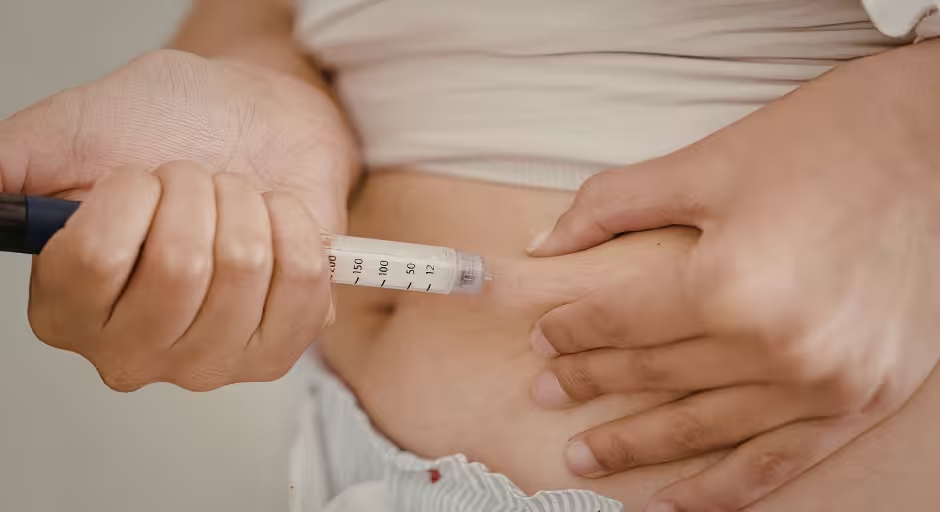
The Wegovy tablet may be welcome news if you heard "weekly injection" and decided you'd rather stay exactly as you are forever. Others couldn't care less about the needle, and these needles are tiny. Nobody's approaching you like they're about to tranquilize a rhinoceros.
Preference, convenience, cost, insurance, your medical history and what you're treating all matter. Which medication is right for you is a conversation with your clinician, not a decision based on how great someone from high school looks in her vacation pictures.
And the shot itself doesn't make weight disappear. It's just how the medication gets into your body. The medication still has to work on appetite, fullness and blood sugar.
One big reason these medications help is that they can make eating less easier.
"Eat less" has been thrown at people for decades as if nobody had thought of it. Knowing something and having a body that cooperates with it for months or years are two very different problems. If a medication helps you feel satisfied with less food or spend less energy fighting hunger, a calorie deficit gets easier. It hasn't abolished biology. It's changing some of the signals you used to fight with willpower alone.
Picture someone who has dieted for thirty years. She knows what a vegetable is. She owns a water bottle big enough to sustain a family of four through a minor emergency. Her struggle isn't knowing what to do. It's doing it consistently while hungry, or while thinking about food all afternoon. If information alone caused weight loss, every longtime dieter would have reached goal weight sometime around 1994. The doughnut has never been masquerading as broccoli.
Human beings aren't spreadsheets. We have stress, hormones, families, budgets, sleep deprivation, celebrations, grief, and Tuesday afternoons when cereal over the sink beats salmon and roasted vegetables. And we have biology.
Cheating at what? There's no international weight-loss committee at the finish line inspecting how you got there.
We take medication for blood pressure, cholesterol, diabetes, depression and migraines. Nobody takes blood-pressure medication and thinks, "Technically my arteries didn't do this naturally." Weight is somehow the one place we expect people to suffer enough before their success counts. If a medication is right for you medically, that's between you and your clinician.
The opposite myth isn't useful either. You don't inject Zepbound on Sunday and get diplomatic immunity from calories until the following Sunday. Your muscles still need protein, your gut still needs fiber, and your body still needs fluids, even on injection day. If you consistently eat more energy than your body uses, a GLP-1 doesn't guarantee weight loss.
I say that gently, because "this medication should do everything for me" and "this medication isn't working the way I expected" are very different situations.
Here's the middle ground: you are not failing because you need help, and the medication isn't a replacement for every other part of taking care of yourself. Both can be true.
Pharmaceutical commercials have such a wonderful rhythm. Someone kayaks across a sparkling lake while a cheerful voice lists seventeen things that may happen to her pancreas.
The most common side effects of semaglutide and tirzepatide are digestive: nausea, diarrhea, vomiting, constipation and stomach discomfort. But terrible side effects are not the goal. Online, people sometimes treat "I can barely get 600 calories down" as proof it's working. That isn't something to celebrate. The goal is better health, not being unable to nourish yourself.
There are also less common but more serious concerns, which is why these are prescriptions and not something you pick from an online quiz and a coupon code. Depending on the medication and your history, your clinician may weigh pancreatitis, gallbladder problems, kidney problems from dehydration, drug interactions and thyroid risks. Wegovy and Zepbound carry boxed warnings about thyroid C-cell tumors seen in rodents (whether that applies to humans is unknown), and they aren't for people with a personal or family history of medullary thyroid carcinoma or MEN 2.
You don't need to memorize that. You do need to know why your medical history matters. The question isn't "My sister lost 43 pounds on it, can I have some?" It's "Is this right for me, given my health, my medications and what we're treating?"

I'd rather you walk into that appointment with questions than with a prescription already picked out:
That last one gets forgotten. Starting a medication is exciting; stopping one isn't nearly as marketable. Think beyond "How much could I lose?" to: What does this look like in a year or two? What if my insurance changes, I can't afford it, I don't tolerate it, or I reach my goal? Those aren't pessimistic questions. They're smart ones.
A medication can be clinically wonderful and financially impossible. Insurance can decide which medication you actually get, even when your doctor prefers another one. I know that personally. Sometimes the best treatment on paper and the one you can get are different. Welcome to American healthcare. Please collect your complimentary headache on the way out.
You've probably also seen compounded semaglutide and tirzepatide online, often sold as "basically the same thing" for a fraction of the price. Here's what I want you to know: compounded medications aren't FDA-approved, so where they come from and who is managing your dose matter a lot. The FDA has warned about unapproved products, misleading marketing and dosing errors, including people getting several times the amount they were supposed to take.
At HealthiCare, if a clinician decides a compounded GLP-1 is right for you, it's prescribed for you and filled through trusted, licensed pharmacies. You get clear dosing instructions, and a care team that cares how your dose is working for you, not just whether your order shipped.
"I found it cheaper on the internet" isn't a plan. A clinician who knows your health, a pharmacy you can trust, and someone paying attention to your dose? That's a plan. Bargain hunting is fantastic for throw pillows. Prescription medication deserves a little more due diligence.
I won't turn this into a checklist to diagnose yourself with while loading the dishwasher. Briefly, approved uses depend on the medication. Wegovy is approved for chronic weight management in adults with obesity, or overweight plus a weight-related condition, along with reduced-calorie eating and more activity. It's also approved to lower cardiovascular risk in certain adults and, as an injection, to treat MASH, a serious liver condition. Zepbound is approved for chronic weight management and for moderate-to-severe obstructive sleep apnea in adults with obesity.
So these medications live in a much bigger medical world than "skinny shot." Blood sugar, heart health, kidney health, sleep apnea and liver disease all matter, and the scale is only one piece of the picture. That's why two people on the "same kind" of medication can have completely different goals, and why someone like me can take Ozempic without losing weight while my doctor still sees good reasons to continue. My experience isn't the standard. It's just my experience.
Weight-loss culture loves universal rules: eat this, never eat that, don't eat after 7, lose this much. Real bodies have never cooperated, and GLP-1s haven't changed that. They have given medicine an extraordinary new set of tools, with clinical-trial results that would have seemed remarkable not long ago. But "remarkable average results" and "guaranteed individual results" are two different sentences.
Back to the woman who has dieted for thirty years. She's tried the programs, counted the things, lost weight and regained it. Now her doctor mentions a GLP-1. I don't want her thinking she finally failed badly enough to need medication. I don't want her thinking she'll never have to think about nutrition or movement again, either. I want her asking: "What could this tool realistically do for me, and how would I use it well?"
Nobody needs to be the villain in someone else's GLP-1 story. The person taking the medication isn't cheating. The person who doesn't want it isn't ignoring her health. The person who loses 80 pounds isn't proof everyone will, and the person who barely loses anything isn't proof she didn't try.
Next week, I'm tackling the real numbers. Not your cousin, and not the person on TikTok who lost 97 pounds while renovating her kitchen. How much did people lose in the major studies, and how fast? How many didn't get the headline result? What does "average" mean for your body? And when is "mine isn't working like hers" worth a conversation with your doctor?
People compare themselves. We're human. My job is to help you understand what you're comparing. You may find your "disappointing" result is perfectly reasonable, or that it's worth a follow-up with your doctor. Either way, information beats assumption, and it definitely beats letting Facebook decide whether your body is doing this correctly.
GLP-1s aren't magic, they aren't cheating, and they aren't identical from one person to the next. Until next time, be kind to yourself, and look for progress that works in your real life, not somebody else's highlight reel.
Ready for support that fits your life? Track your food, weight, activity and BITES in the Healthi app, free or with Pro, at healthiapp.com. Or explore GLP-1 care with HealthiCare at healthicare.com.
This article is for general information and isn't medical advice. Talk with your healthcare provider about whether a GLP-1 medication is right for you.
November 12, 2026